Small Kitchen Breakfast Nooks That Leave Room to Cook
Small Kitchen Breakfast Nooks That Leave Room to Cook The best seat in a kitchen might be the one where you can butter your toast and talk to the person at the hob…
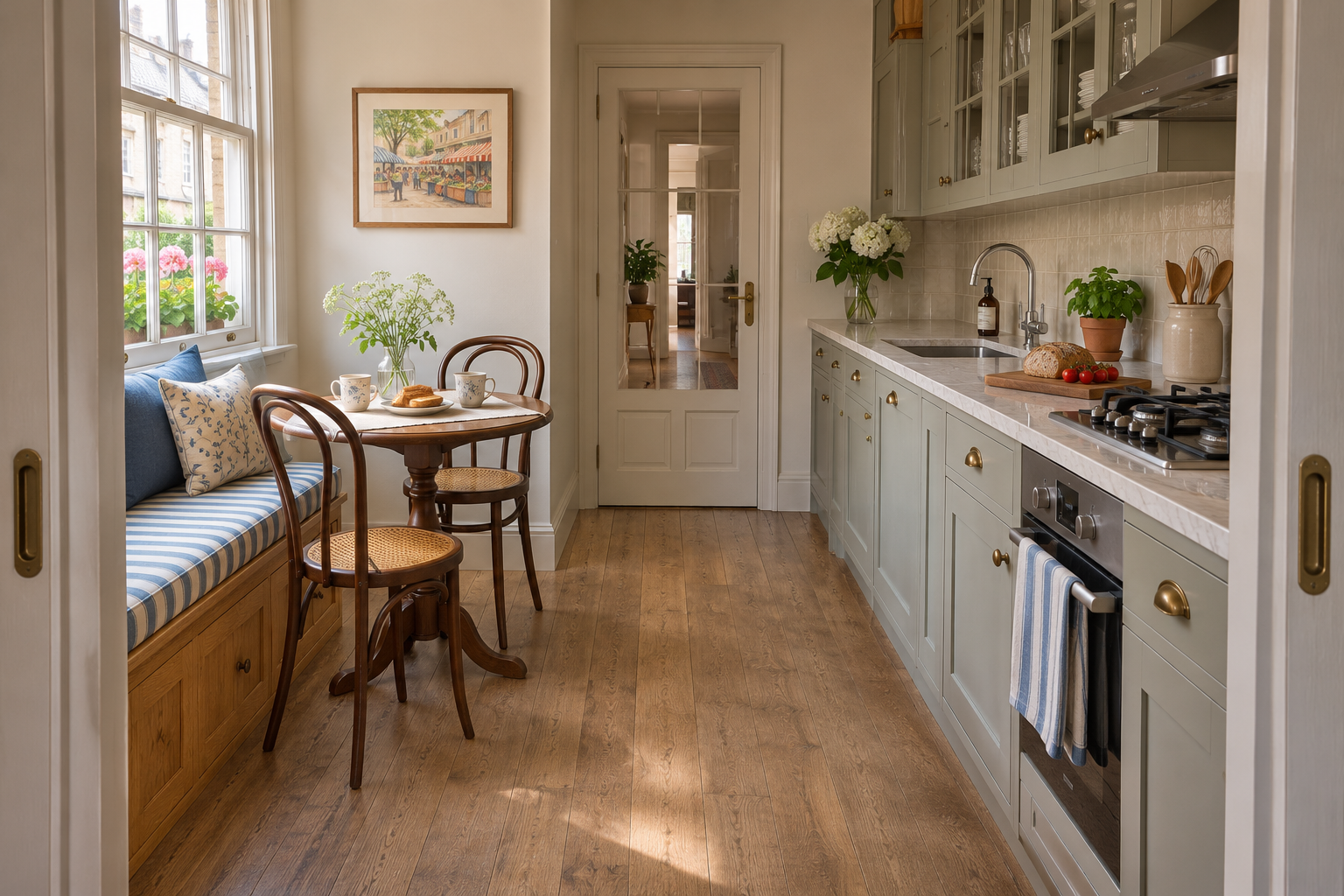
The best seat in a kitchen might be the one where you can butter your toast and talk to the person at the hob without having to stand up every time they need a saucepan. Small Kitchen Breakfast Nooks That Leave Room to Cook start with that ordinary moment. Where do your elbows go? Which drawer holds the spoons? Can someone reach the milk while you finish your coffee?
A chair and a piece of cardboard can answer those questions before you spend anything. Here’s how to find a spot for breakfast that still works when the chopping board comes out and dinner is on its way.
Find a breakfast nook outside the kitchen work aisle
Trace the route from fridge to chopping board
Make breakfast as usual and notice where your feet take you. Perhaps you fetch eggs from the fridge, wash spinach, then turn towards the hob. Meanwhile, someone else walks straight from the doorway to the kettle. Mark the places where your paths cross with little scraps of paper. A quiet patch beyond those crossings is a promising place for a seat. In a galley kitchen, that might be the end near the window, even if the longer wall halfway down looks more inviting on paper.
Measure the nook with someone in the chair
Pull a dining chair up to a makeshift tabletop and ask someone to sit as they normally would. Measure from the back of the occupied chair to the cabinet handles opposite. Now open the dishwasher and try putting a plate on the bottom rack. That bending movement tells you more than measuring the open door alone. Try the same test with your deepest drawer. If either task makes your breakfast companion lean forwards, turn the table a quarter turn and repeat the test.
Tape out the breakfast table before buying
Cut a piece of cardboard to the dimensions of a table you like. Draw around two breakfast plates on it, then add your mugs, the butter dish and whatever usually gets squeezed in last. Leave a place for the teapot as well. Put the template on a stable table at roughly the right height and live with its outline for a morning. You may discover that a little extra length along the wall helps more than extra depth projecting into the room.
Match space-saving breakfast tables to the shape of the room
Give a galley kitchen a fold-down table
At the closed end of a galley, a wall-mounted drop-leaf table can give two people a window view. Decide where the chairs will live when the leaf is down, because they still need floor space. For example, a folding chair might hang in a nearby cupboard while the other serves as a desk chair. To see how two leaves can work independently, look at IKEA’s window-side drop-leaf table arrangement.
Pair a corner banquette with a pedestal table
A bench along one wall gives you a seat that nobody has to pull backwards. Put a small pedestal table in front of it and see whether you can slide in from the open end. Pay particular attention to the foot of the pedestal. A broad disc can occupy exactly the spot where you want to plant your heel. If you like to stretch one leg while you read, sit through a cup of coffee before deciding whether the pairing feels comfortable.
Try a slim breakfast ledge for one or two
A shallow ledge suits a household that eats side by side. Lay a placemat on the proposed surface and set out your usual breakfast. If your bowl fits but your forearms hang over the edge, try a deeper top or a different orientation. Sit facing into the room as well as towards the window. A ledge at the end of a cabinet run can give you a view of the person cooking, which might matter more to you than the view outside.
Choose compact kitchen seating you can comfortably use
Fit the breakfast bench to the people who use it
Borrow a chair that feels good and measure its seat height and depth. Use those measurements as a starting point for your bench, including the cushion you intend to use. A thick pad can lift your knees surprisingly close to the underside of the table. Likewise, a deep seat may leave a shorter person perched at its front edge. Try a firm back cushion and check that your feet settle comfortably while your shoulders stay relaxed over your plate.
Give pull-out seating an easy way in
A stool that fits neatly under the table can still be awkward to use. Pull it out, sit down, then stand while someone occupies the next seat. If you have to grip the tabletop to steady yourself, try a chair with a supportive back or arms. When one person needs easier access, give them the open end of the table. The other person can take the bench against the wall, and both can leave the table on their own terms.
Put useful storage under a kitchen banquette
Think about what you’ll retrieve while someone is eating. A lift-up bench works well for spare linens or the big serving platter you use on Sundays. Napkins, however, deserve a spot you can reach during breakfast. An open basket at the end of the bench lets a guest take one without everyone getting up. Before choosing drawers, pull a box of similar depth into the aisle. You’ll soon see whether you can reach the contents with the table in place.
Connect a breakfast corner to light, art and adjoining rooms
Follow the morning light to your window seat
Try the seat at the hour you usually eat. A window that looks lovely at noon might put the early sun directly in your eyes. A café curtain over the lower panes can soften a street-level view while leaving the sky visible above. If your window opens inwards, swing it fully open over the cardboard tabletop. Check the teapot and the back of the tallest chair, too. A windowsill is a happier place for herbs when you can still reach the latch.
Hang kitchen art where diners can enjoy it
Sit on the bench and ask someone to hold a favourite print against the wall. From that lower viewpoint, you may prefer it a little closer to the tabletop. Pick a piece with a detail worth lingering over, such as a market scene or a drawing of the street where you live. Echo one colour in a washable seat cushion. That small repetition gives the corner a sense of belonging, and the tabletop stays free for another plate.
Keep a sightline into the reception room
Stand in the adjoining room and look back at the nook. If tall chair backs cut across the opening, try a low bench on the shared side. A guest can then join the conversation from the sitting room while the cook finishes lunch. On the other hand, you might love a quieter breakfast. Turn one seat towards the window so its occupant can look out with a newspaper. The same opening can support company and privacy, depending on which way you face.
Look at the floor between the two rooms as well. A runner that catches under the breakfast chair can make an otherwise generous opening feel awkward. Slide it aside for a day and see whether people move more freely, especially when someone is carrying dishes back to the sink.
Make your small kitchen breakfast nook work all week
Set the table for your busiest weekday
Put out everything that lands on the table on a typical Tuesday, including the lunchbox waiting to be filled. Give the things that stay all morning a home within reach. A breadboard can stand on edge beside the bread bin, for instance, and a washable tray can carry jam and honey back to the cupboard in one trip. After that, you should have enough clear surface to sit down with breakfast while someone else packs lunch.
Rehearse a weekend breakfast with guests
Invite someone to sit in the extra chair while you carry an empty serving dish from the worktop. Notice whether you turn sideways or ask them to tuck in. Sometimes serving from the open end of the table solves the problem. Sometimes the spare chair works better just inside the adjoining room. If that spot feels disconnected, revisit the ideas for keeping a sightline into the reception room.
In conclusion, keep the seat that earns its place
Give your trial layout a few mornings. The detail that settles it may be modest. Perhaps you can finally finish a coffee while it’s hot, or a child can tell you about school while you chop an onion. Keep the arrangement that makes that moment easy. A breakfast nook has earned its corner when somebody wants to sit there and the cook can carry on.
Found this useful? Save it for later.